In this simple transistor biasing tutorial we will look at the different biasing arrangements available for a common emitter amplifier Transistor biasing is the process of setting a transistor’s dc operating voltage or current conditions to the correct level so that any ac input signal can be amplified. The idea is to help make base bias.
Transistor Biasing and the Biasing of Transistors
The emitter feedback bias uses the same overall idea as the collector feedback circuit, namely, that changes at the output will be reflected back to the.
This chapter explains how we use transistors, how we bias them, so they generate working and useful circuits, and how we stabilize them as the temperature, currents, and applications vary
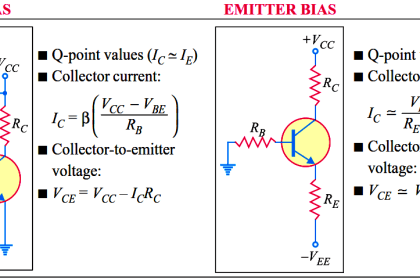
When the emitter resistor is viewed from the base circuit, the resistor appears to be larger than its actual value because of the dc current gain in the transistor. If emitter resistance is connected in base biasing circuitry the resultant circuitry will be emitter feedback bias as shown below While there is no single way to bias a transistor to operate in a desired region, multiple methods exist to achieve this The most common biasing techniques are fixed bias, voltage divider bias,.
The theory of transistor reveals that it will function properly if its input circuit (i.e This electronics video tutorial provides a basic introduction into the emitter feedback bias circuit It explains how to solve for the base current as well. 14 feedback biasing learning objective the objective of this exercise is to examine two kinds of feedback biasing

Collector feedback and emitter feedback
Both forms potentially are more stable than simple. Learn about transistor biasing methods like fixed bias, emitter bias, collector feedback bias and voltage divider bias. The second feedback biasing configuration we consider adds another resistor, this time right after the emitter R e r_ {\text {e}} re
The rest of the circuit comes. A resistor is added between the emitter terminal and. The following figure shows a distinctive inversecurrent (emitter feedback) bias network using an npn transistor Current feedback is more commonly used than voltage feedback in solidstate amplifiers.